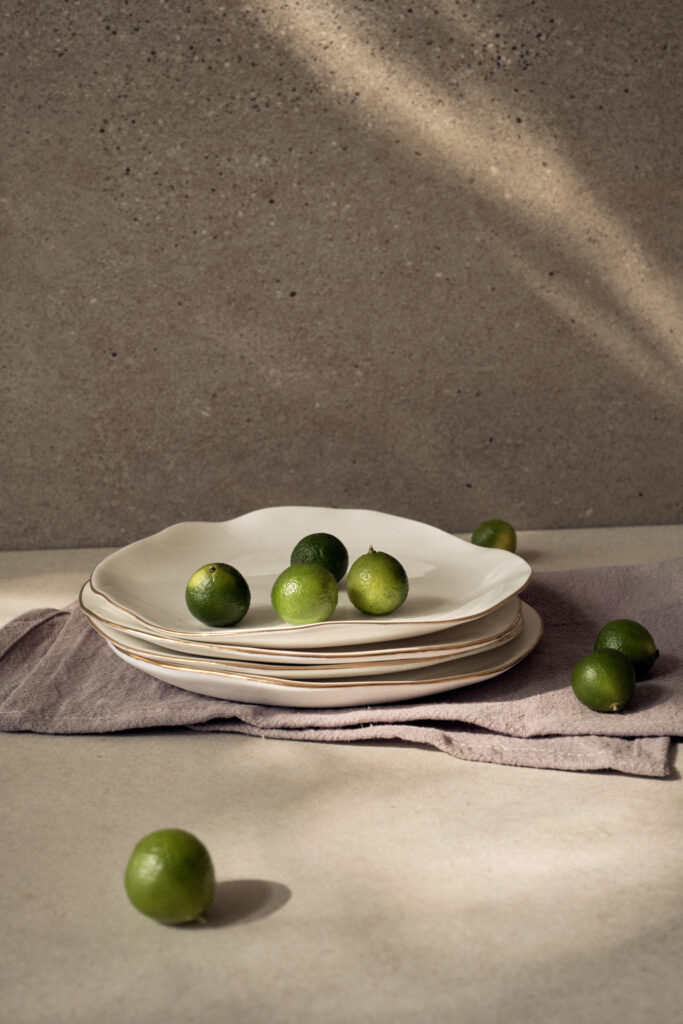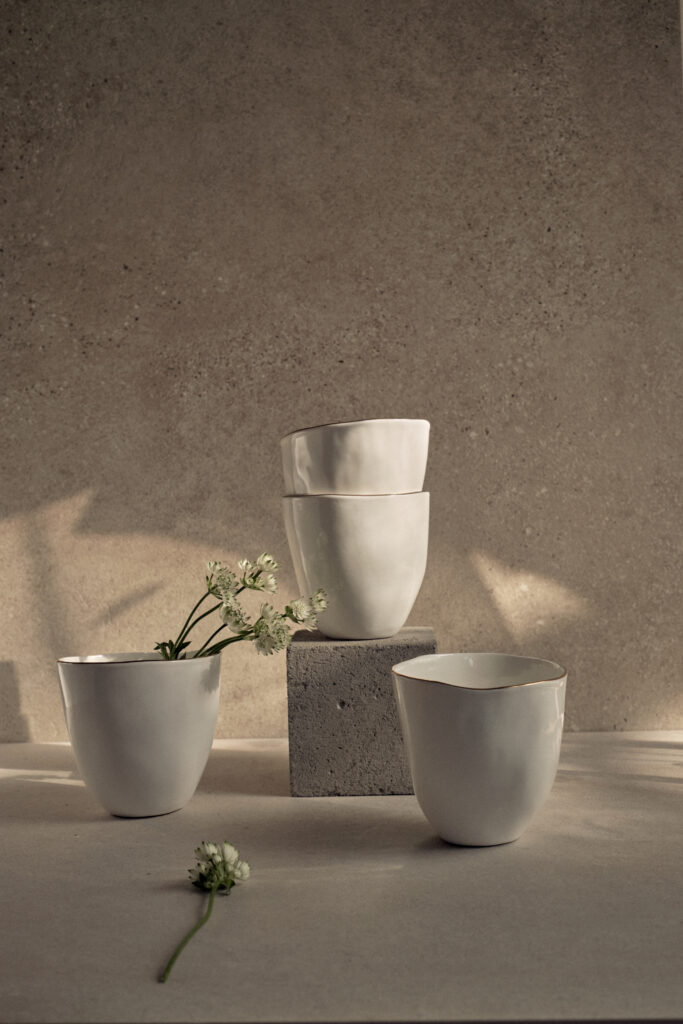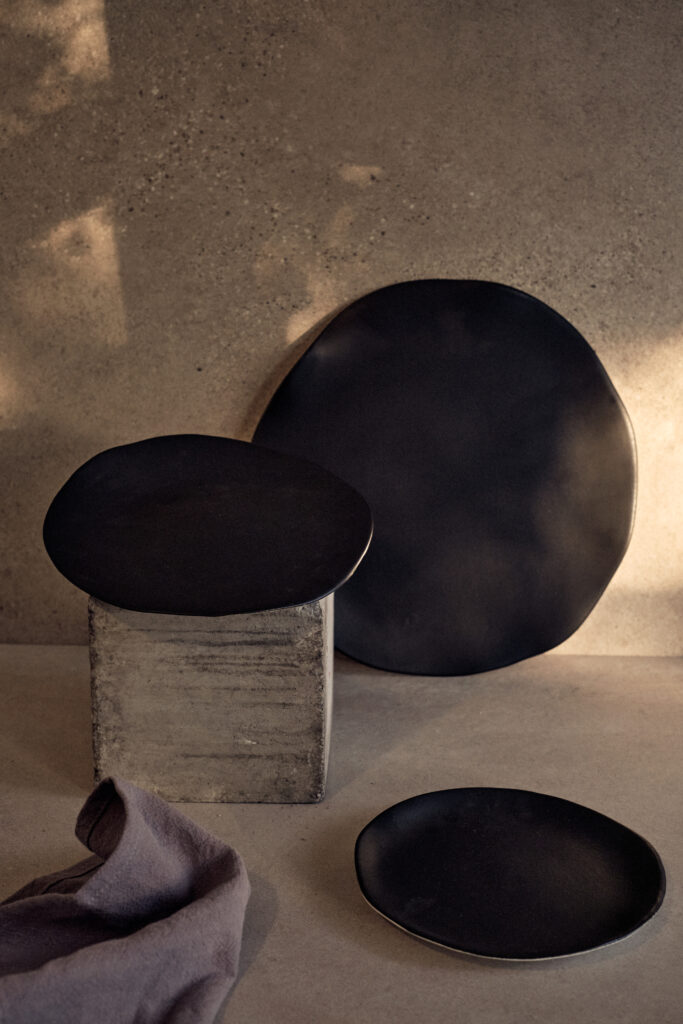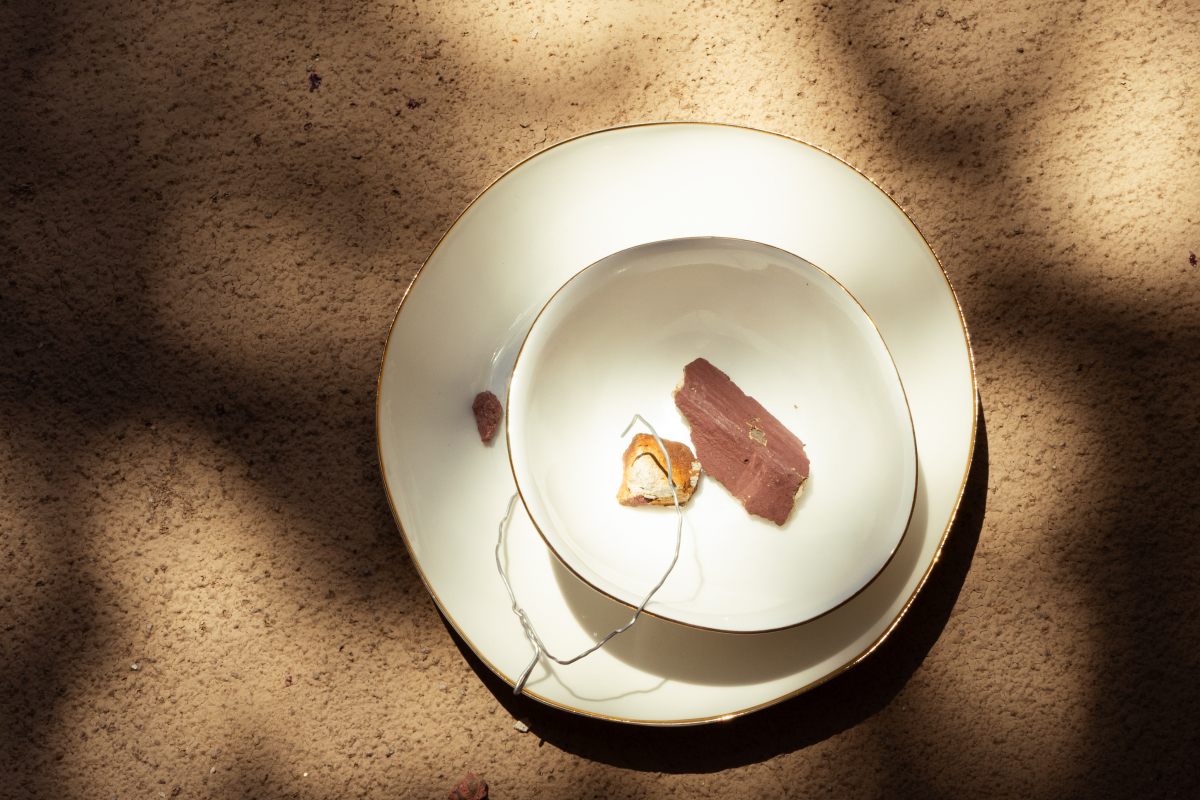
Laura Letinsky is an internationally exhibited artist whose photographic practice rethinks still life as a way of reading everyday life. Emerging from her sustained engagement with still life and material culture, Molosco translates this visual language into dinnerware made for touch, use, and reflection. We sat down with Laura to explore the relationship between her photographic practice and ceramics, as well as the craftsmanship and thinking behind the founding of Molosco.
For the people that are encountering you and Molosco for the first time, could you just briefly introduce yourself and describe what you practice today and how Molosco sits in that?
I've been an artist for a really long time. All my life, one might say. When I was in college, I ended up being a double major in ceramics and photography. I pursued photography as a graduate degree as it gave me another kind of language, a way of communicating, not unlike words or poetry or literature. I felt that I could speak it with a kind of fluency and eloquence that for me felt like a whole different way of engaging the world and speaking about the world. Photography is so ubiquitous, it's everywhere. Engaging in the medium gave me another way of thinking about how I understand the world instead of how I'm told to understand the world through mainstream media, much of which promotes a certain way of being in the world, a set of values about what's beautiful and what's good.
I wanted to push against that and instead try to find things that I thought were important and valuable. It's very important to me that the photograph reads as a photograph and pushes against the fantasy of advertising photography that shows a perfect world, but never the labor and effort and resources that it takes to make a notion of perfection. Instead, I want my pictures to be beholden to the fullness of being alive.
I've been making photographs for over 20 years, and around 2009, when the iPhone had been around for a couple of years, I felt like I was drowning in photographs. Photographs were everywhere, and the facileness of them became really disturbing. The way that we were being instructed to make food that looks good, or the way that people were making themselves look good on Instagram or TikTok, as opposed to being informed by reading literature or books or politics or news. I felt like I was always being sold something, be it a product or a message that I didn’t necessarily want or agree with.
Was this a rejection of photography, or a need to slow it down?
I needed something much more tactile, more material, more real. In addition to cooking a lot, I also sew many of my own clothes because I'm interested in how things are made, in trying to understand the process. And I also really have a terrible desire for really expensive clothes but I can't afford all the things that I like, so I thought, well, maybe I can learn how to make them.
At that time, I wanted a bowl for fish soup because I'd been making a French one but didn’t have the right bowl to eat it from. I didn't like the pho bowls as they were a little too big, and I didn't like flat soup bowls either. I wanted something that felt good in my hand, like a person you love, a beloved object. I had access to a ceramic studio so I started to attempt making my ideal soup bowl. It had been over 20 years since I'd touched clay but it was like coming back home again. I didn't even think about it, it was a very unconscious gesture. Once I started, I became quite obsessed. I made a whole dinnerware set and kept making it. I used them all the time. Then, one day when Max was in my studio and saw them, he suggested that we make them available on a bigger scale, and that was how it started.
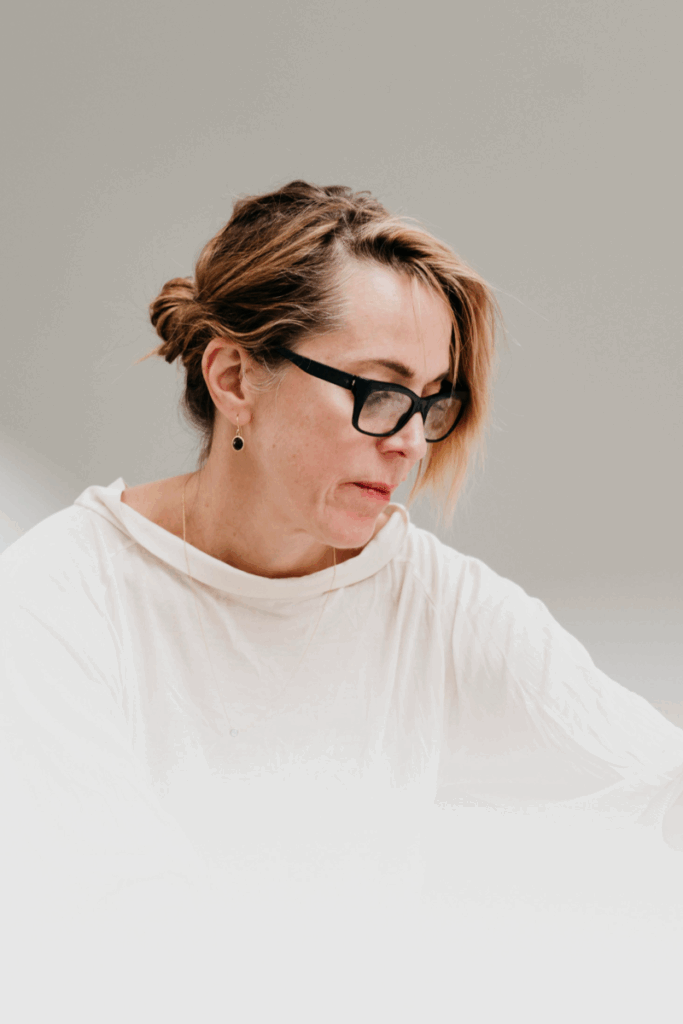
Laura Letinsky
A lot of your work, especially from the early 2000s on revolves around set tables, food and leftovers. How does it inspire your work in Molosco? Is there a coexisting relationship between your artistic practice in photography and Molosco with actual objects?
Absolutely. My interest in still life came from an interest in Dutch and Flemish still life. I understand that the Dutch turned to still life at that moment in time in response to politics and economics, that is, their ideology. It was a colonialist era, and the Dutch were sailing all over the world, along with the Spanish, the Italians, the Belgians and the French, to Africa, Asia, and the Americas, and bringing back these strange and gorgeous things. They didn't have a tradition of displaying their wealth the way the Catholics did. Instead, their protestantism advocated living modestly and being a good person at home and within their community. Their images of their conquests were described so as to display and advertise what they had, serving as proselytization, an advertisement to say, if you work hard and are a good person, you too can have these gorgeous objects or these lovely things. You don't see any of the labor or the pain or the violence that wrought this wealth, just this beautiful invitation to enjoy this pleasure. And because they needed to spread this idea far and wide so as to insure a work ethic amongst the masses, they needed these images to be reproducible. As well, in their travels, there was a need to show others what they were seeing. Photography develops out of these imperatives.
Today, advertising shows us things that inspire our want. We are visually triggered by images to want what we are shown. And now, in our post-global world, everything is available from Thai noodles from Thailand to Chilean grapes, French foie gras, champagne, blue cheese - all at our local Costco.
Photographs privilege sight, but in this, we’ve lost our other senses as well as the understanding of where things come from, its context. In my photographs, I want there to be a texture, a sense of physicality, paper that’s been touched, crumbs, a lipstick stain on a glass. For Molosco porcelain, I wanted this sense of touch to parallel the pleasure of how it looks as experience, as engagement, a warmth vs. a clinical cool “perfection”.
It’s not that I am interested in imperfection. I think life is rich, not antiseptic or airbrushed. We are sensory beings, dependent upon more than just our eyes and I want in my work, be it photographs, textiles or Molosoc to revel in this life. Not just accepting but seeing the signs of life as evidence of life lived.
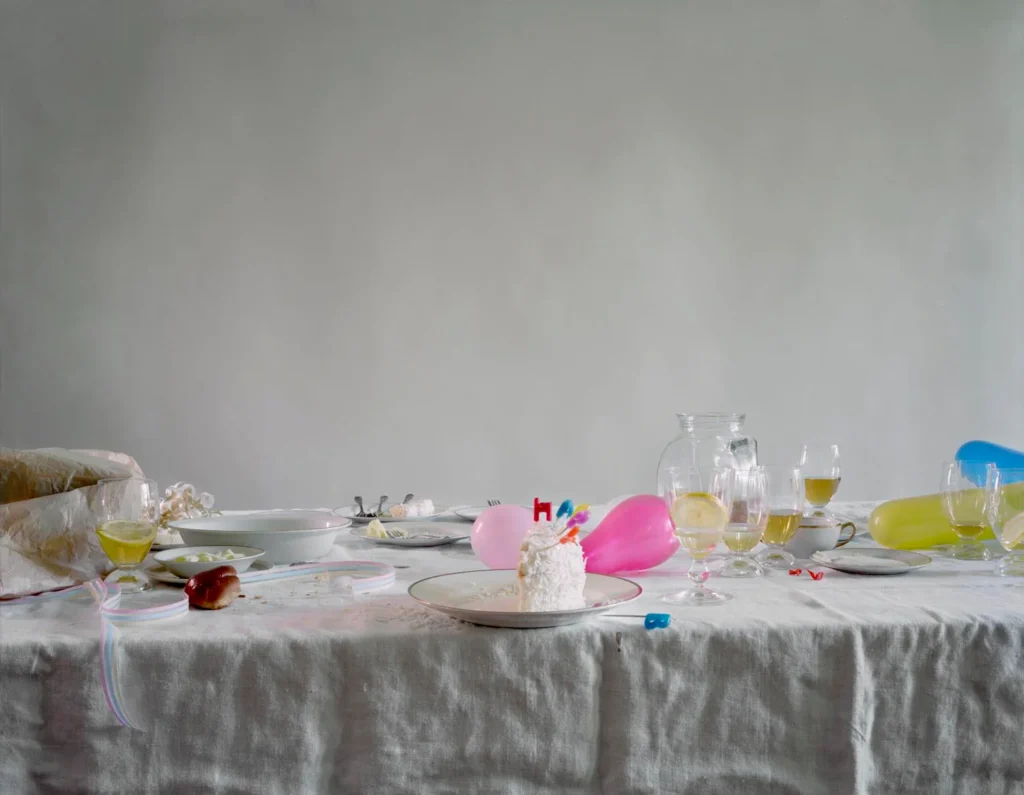
Untitled #1, The Dog & The Wolf, 2008
How did that idea of finding beauty in handmade, ‘living’ objects influence your decision to produce Molosco in Jingdezhen, China?
It is the birthplace of porcelain, where porcelain started, over 2,000 years ago. Making Molosco there made so much sense because of this lineage and wealth of artisanal and creative makers.
I did encounter a cultural difference working there; the artisans and the industry has encouraged sameness, the perfectness of a repeatable smooth geometric form that has been arrived at through their rich history. When encountering my organic shapes and affection for the handmade, there was some confusion. Talking this through with others became an interesting point of discussion.
I’ve rethought my ideas regarding originality and invention that are heralded in our “western” culture as of supreme value. Whereas in other cultures, including China, the idea of the copy relates to homage, and honoring what comes before with apprenticeship as a common form of learning (fuzhipin - 複製品). More contemporary critical thought articulates that what we know is always beholden to what came before. We can't know anything new as we would have no means of recognizing it except by comparing to what is already known. Being able to have the time in Jingdezhen was very valuable for me as an artist and as a person.
So how did they react to this when you first started working together?
It's been a translation process. At first, they did not get why I wanted that organicness that was unique to each object. I explained that I wanted the sense of touch, the sense of hands, the variances, that I thought this was beautiful. But as it's so ingrained in the industry that everything should be identical, “perfect”, I was in the crosshairs of very different traditions. It made me cognizant of how different cultures express and shape ideas of individuality and the collective. This pertains not simply to dinnerware but to all aspects including social rules and regulations that one takes for granted such as mask-wearing or obeying traffic laws. What is freedom in one culture might not be understood as such in another.
When you visited Jingdezhen, what were your impressions of the craft and the process?
Incredible technicians. Unbelievable technicians. It's a science, the process of porcelain- and glaze-making. There are huge universities there, much bigger than the one I teach at, that do only ceramics with extraordinary knowledge about materials from the porcelain clays, glazing, forming, firing…. It's a mind-bogglingly huge industry.
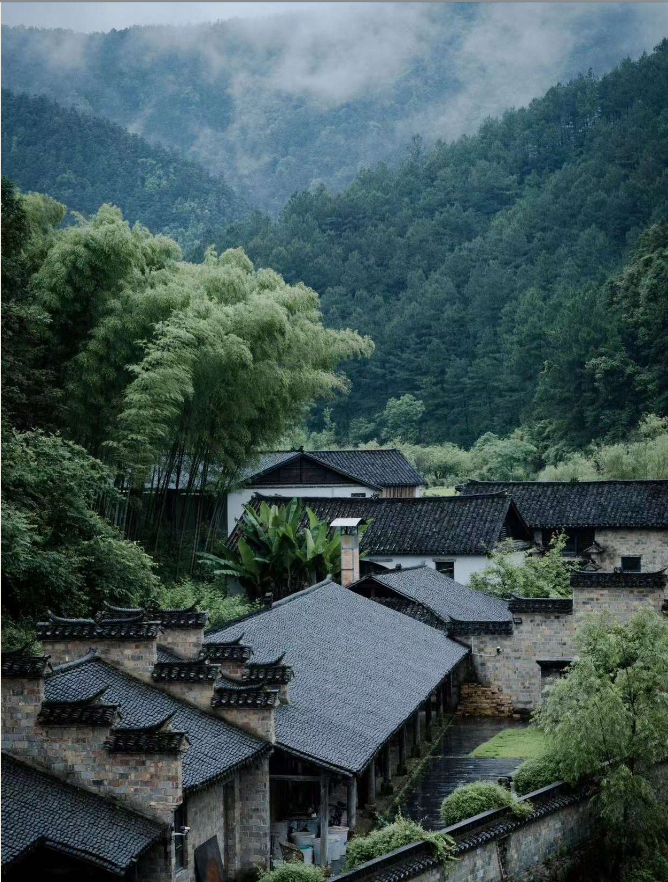
Their museum is also incredible as it is designed on the model of the old kilns formed on the sides of mountains. It's a stunning set of structures. In the countryside there are towns that give you a sense of what life was like several hundred years ago. It is a very different sense of time compared to the incredibly technologically sophisticated big cities such as Shanghai and Hong Kong.
I'm romanticizing some of this, but seeing how people live, utilizing traditional methods of food production from growing vegetables in small spaces, roofs, yards, along with chickens, it feels more holistic. Even relying upon the air to dry one’s clothes, not seeing it as something to be hidden or done elsewhere, to me, makes so much more sense. In that region this life is helped by the climate. It's humid, warm, and verdant. The landscape looks like a Chinese painting with little mountains, hills, brooks, and bridges.
Jigndezhen, China
How did being there change how you think about materiality in your own work?
It reinforced things. I make things. I care about engaging in the messiness of the process as it feels fuller, dare I say, profound. I have a community garden and care about where my food, what I put in my body, comes from and its quality of taste. It’s odd and frustrating to me that today, most people don’t seem to know or care. I had a student who thought potatoes grow on trees. We buy our food wrapped in plastic, picked green then ripened by gas or in transit, our meat from animals raised in horrendous circumstances, bones removed so that we don’t have to think of where or what it came from.
Again, with my work, I want there to be a sense of the circuitry of connection. In my photographs, this is more a question, not making sense of our frenetic condition, but in Molosco, the warmth of the dinnerware is welcoming not only for the eyes, but for the body as a whole.
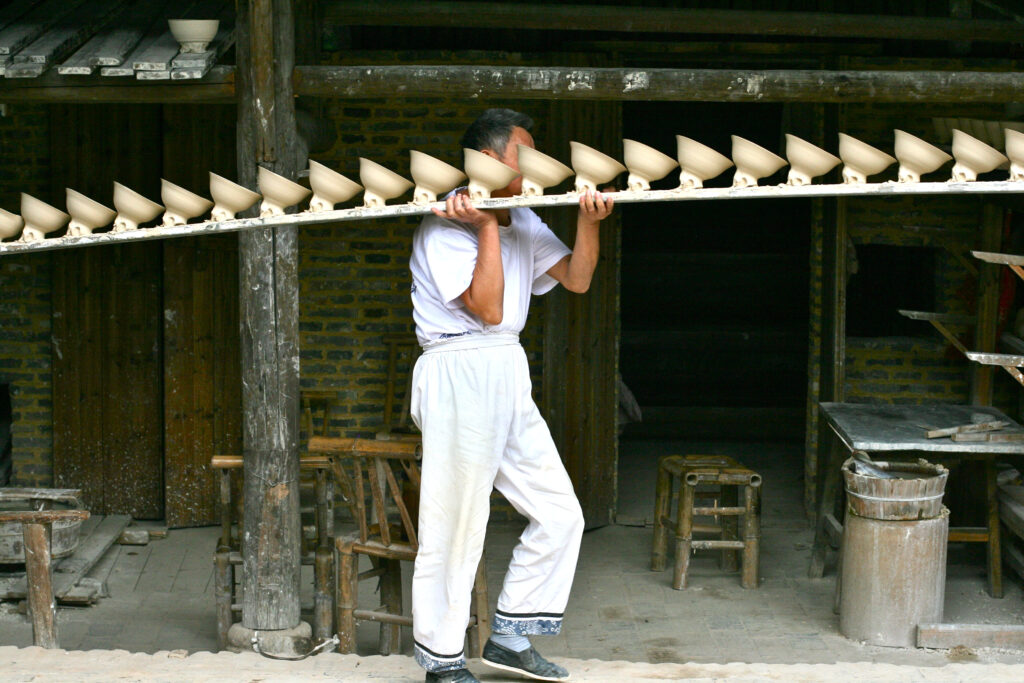
Photo by François Philipp, via Flickr (CC BY 2.0)
At Molosco, the way you work is very paced and slow, in a world led by speed and scalability. What does that enable in your work and your product?
Another impetus to making Molosco was receiving a catalogue with beautiful dinnerware and wanting what I saw while reminding myself that I was just responding to fashion.
Molosco is a way to appreciate what you have. I used the gold lip on Molosco to go with the many dishes I’ve collected over the years including my grandmother’s china. No one else wanted it and I didn’t love it but because it was hers, my affection grew. Through marriages and divorces, I’ve got more pieces as well as my inclination for thrift shopping. I have many variations of plates that are tied together by this gold lip and they all harmonize beautifully.
The idea of one perfect matching set is anathema to me because with life, chips and cracks happen. To embrace these, along with the way life comes together is to develop a fuller and richer life of memories rather than just things. To add Molosco to your life is to build upon this. To invite a dialogue with the rest of your life, a conversation.
We started by talking about how your photography shaped Molosco. I’d love to end by asking whether Molosco, and your return to ceramics, has reshaped the way you see and make photographs?
For sure, and also, it spawned a deep dive into porcelain-work. I’ve also made a number of vases that I call Preparing for Flowers. These vases are a means to consider or anticipate a future. How does one go about doing this? How do you make a life, have hope, fulfill, or not, a promise?
When I was making the vases, I was trying to make as thin and as tall a vessel as I could. An object reaching for the sky. It’s really hard to do and it is fragile, often breaking. My repair, with brightly slightly obnoxiously colored epoxy speaks to the process of being alive. One tries, perhaps fails, there’s flaws and eases, and one goes forward. Delicacy and vulnerability, as well as adaptation are, I think, the highest values. With Molosco, it's very peculiar for the artisans there to work with us because the pieces aren't perfectly round or perfectly even. And trying to explain why I value that becomes an interesting conversation.
Verticality and horizontality, those axes, are in my photographs, constants that I negotiate. I want to remind those who see my images that all images are a distillation, a flattening that, like a magic growth capsule, can also expand and take another form. I mean this metaphorically as well as literally.
I’m always interested in how working across different practices allows them to inform, challenge, and sharpen one another.
Absolutely. The different practices talk to each other. Sometimes people ask me why I don’t put images on my ceramics, or why the ceramics don’t look like they’re meant to be photographed. But they are the same ideas, the same set of issues I wrestle with that are, necessarily, manifest differently in different media. It's all about being in the world.