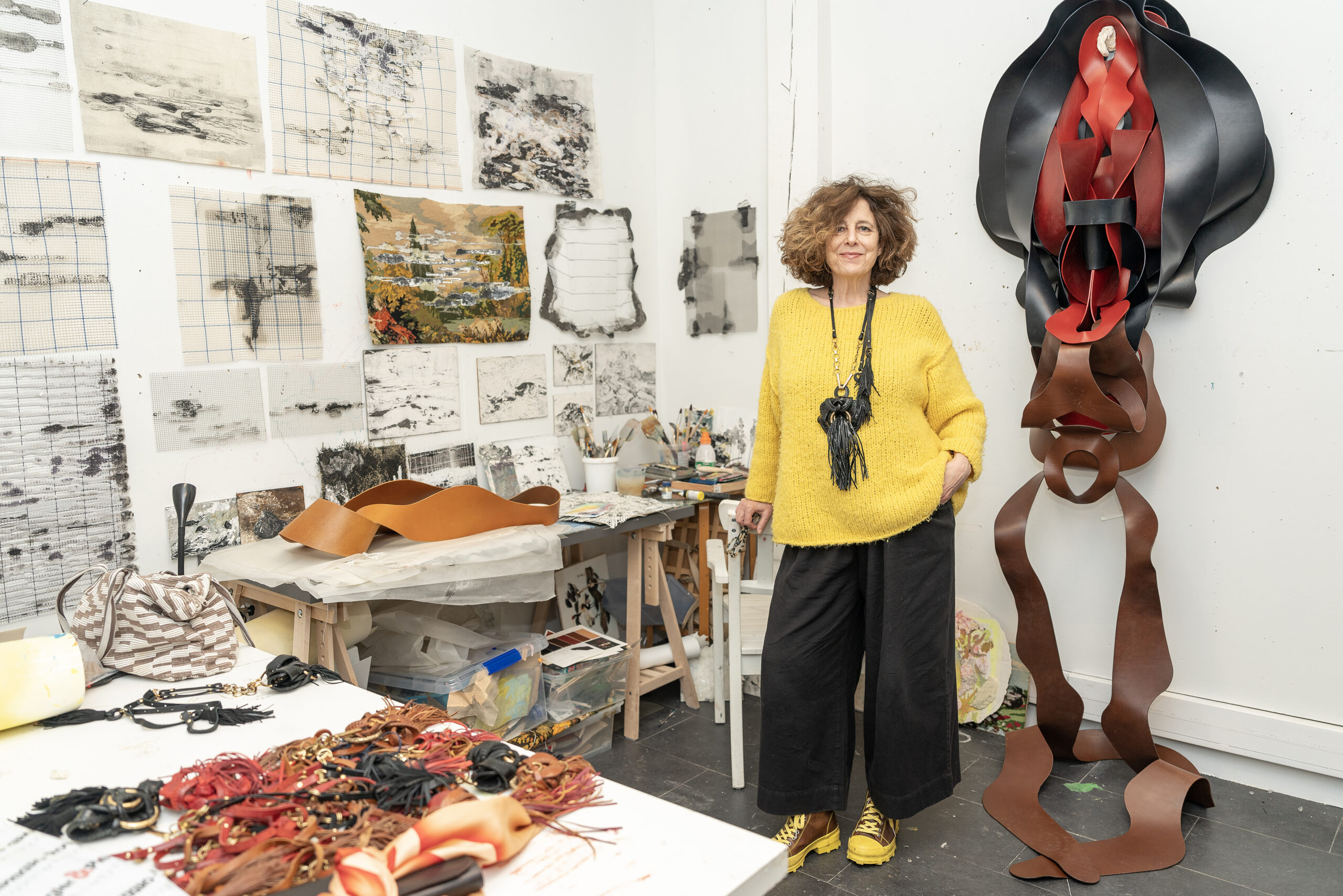
For artist Maggie Cardelús, materials are not simply shaped but listened to. In our latest In Process, Cardelús traces how a NeckPiece takes form, from paper, to surplus leather, to cast bronze, guided by what she calls material intelligence: an understanding built through years of working by hand. Each piece begins in uncertainty and ends on a body she hasn't met yet.
We spoke with Cardelús about the intelligence she finds in her materials, how it shapes her craft, and what she intends happens when a NeckPiece finally reaches someone's body.
Maggie Cardelús in Paris studio, image courtesy of Maggie Cardelús
Maggie Cardelús is a Spanish-American artist who lives and works in Paris, France. Her broader practice moves across wall-based work, sculpture, installation, performance, and video, and is grounded in a deep commitment to working by hand. Much of it begins with photographs, often family images, which she treats less as pictures to look at than as physical material to be reworked, folded, cut, and rebuilt into something closer to an object than an image. That same instinct has carried her into other media over the years, from ceramics to painting to textiles, always testing how far a photograph can be pushed before it stops behaving like one. Alongside her practice, Cardelús has founded her own brand, under which she creates highly crafted collections of wearable sculpture she calls NeckPieces.
Cardelús describes her process of creating her NeckPieces as a physical language developed through her years of making, allowing instinct to guide the work before intention can define it. "My formal vocabulary lives in my hands by now, and I yield to them," she says. "It's pure pleasure to let my hands converse with the material and let the forms emerge on their own terms. The forms aren't designed so much as arrived at."
That distinction sits at the centre of Cardelús's NeckPieces. In her studio, a NeckPiece begins as paper. Nothing is decided yet; nothing needs to be. "I start with some very vague form in my head," she says, "and with paper that I cut into shapes and play with over weeks, until something begins to build up on its own."
As paper eventually gives way to leather, "the process, in a way, begins again," she explains, "because leather has its own personality." Leather resists, bends, softens, and pushes back. Bronze introduces another set of demands. What begins as an idea becomes an ongoing negotiation between maker and material. "What I intend, what the leather wants, what the cast bronze rings want, what the form itself wants, all turn out to be different things," she says. "So I become, in a way, a mediator." Rather than forcing those competing impulses into resolution, she steps back to allow form to find itself.
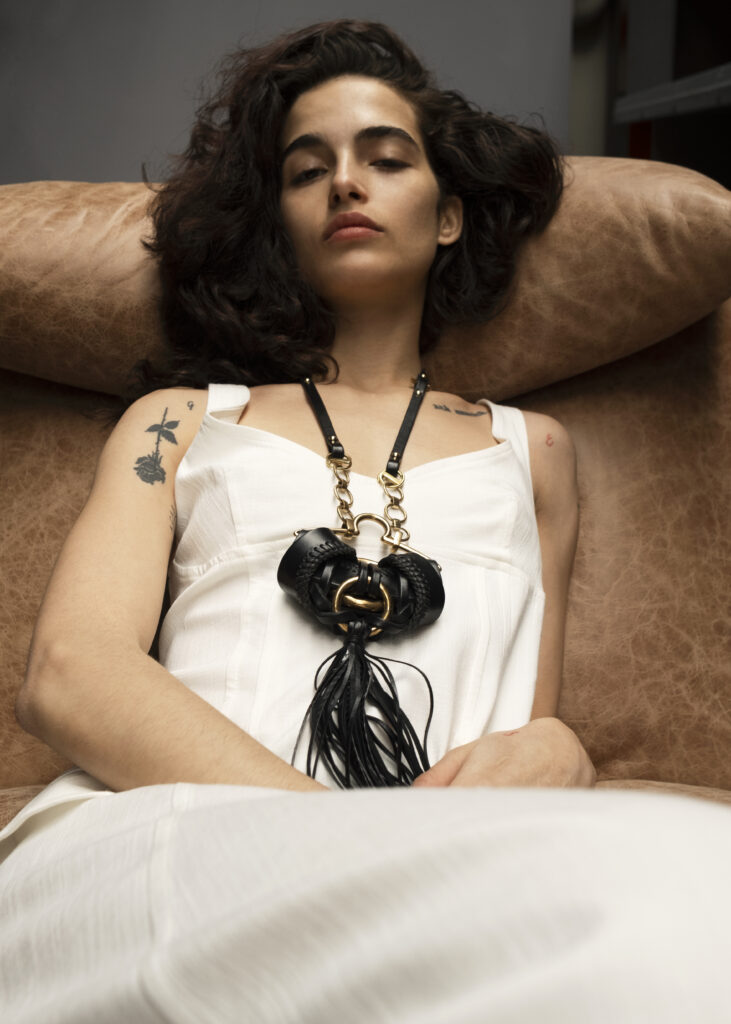
Knot V NeckPiece, image courtesy of Nilufar
Material Intelligence
She calls the knowledge required to work this way "material intelligence:" an understanding that comes only through prolonged contact. Her relationship with leather began with a commission for Sonia Rykiel in 2018, followed by deeper study with wildebeest hide in South Africa and time spent with leather craftspeople in Paris; "There's a kind of knowledge you only get from staying with a material for a long time," she says. "None of that is knowledge you can shortcut, just like you can't rush a truly deep relationship with another person."
Material intelligence, then, is not mastery in the conventional sense. It is attentiveness, "Leather's material qualities, its pliability and resistance, its give and take, are how it speaks to me," she explains. "It's actually where the intelligence lives. Not in what I impose on it, but in what I'm attuned enough to notice." That attentiveness extends to the history carried by the material itself. Leather, she notes, is one of the oldest materials humans have worked with "a material humanity has trusted against its own skin for tens of thousands of years, closer to us, in that sense, than almost anything else we make things from." Cardelús's work with surplus leather rather than newly produced hide means that everything she handles has already existed in more than one context. "Every piece I use already had at least two lives before it got to me," she says. "First, it was an animal." Then it became surplus: material intended for another purpose, cut and eventually set aside.
For Cardelús, those histories remain present. Leather carries "the smell of it, the particular warmth [it] has that no synthetic material replicates, [...] the way it still moves like something that was once alive rather than something manufactured to imitate life." Working with surplus means beginning not with endless possibility, but with limitation. "I'm not starting from a blank material," she says. "I'm starting from something finite, something that already carries stories I had nothing to do with." That constraint is productive. It requires her to respond to what already exists rather than imagine material as neutral or infinitely replaceable. Sustainability, in this sense, is direct: "using material that already exists rather than asking for more to be made."
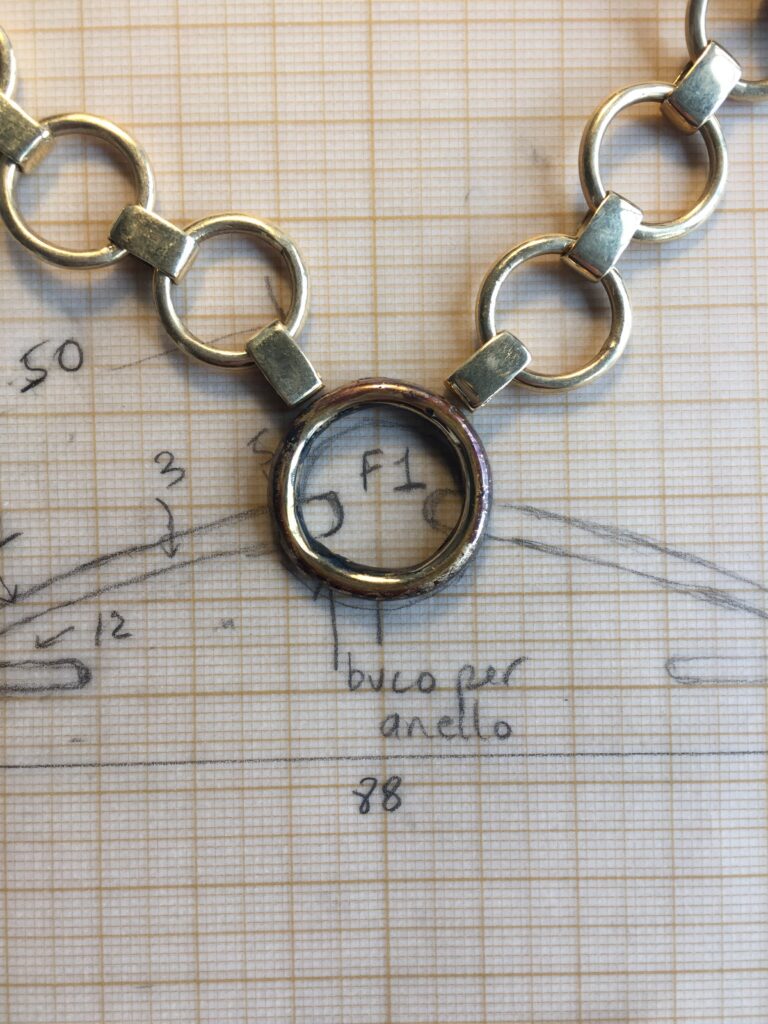
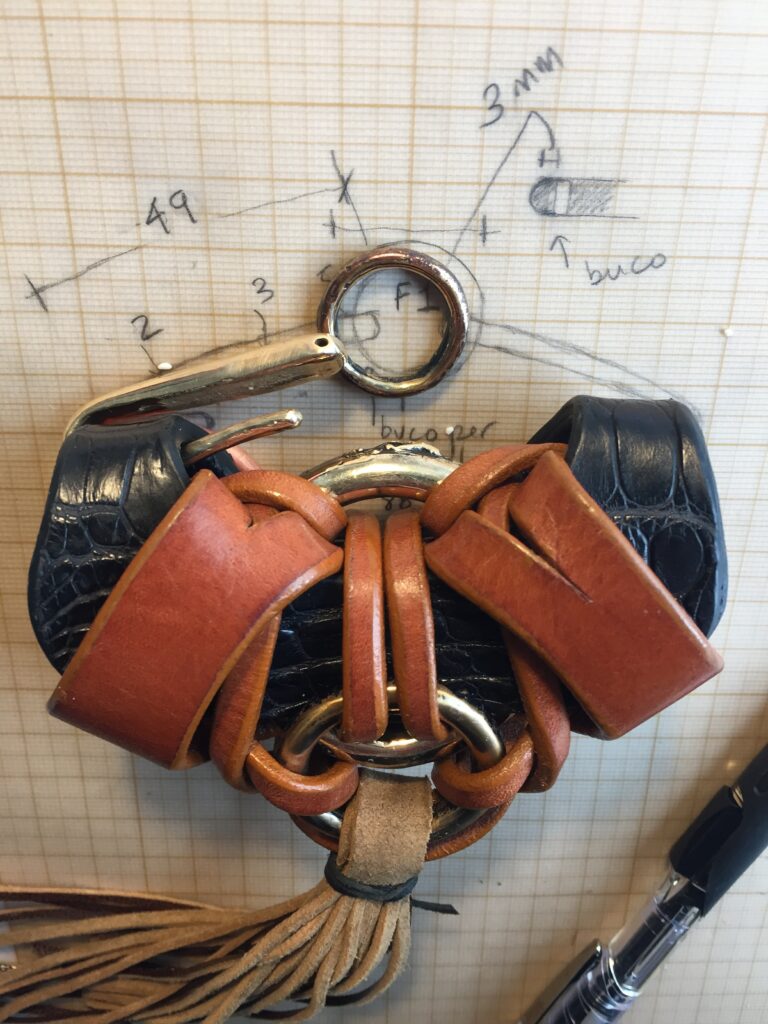
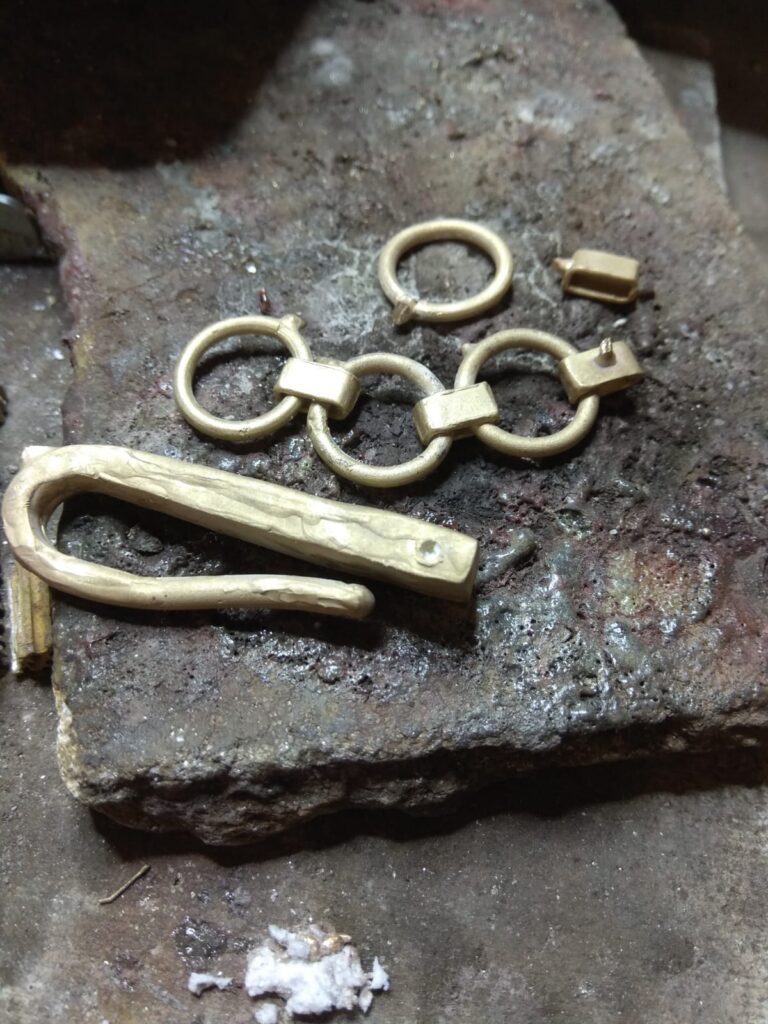
Process Images Courtesy of Maggie Cardelús
Changing Hands
Throughout her creative process, Cardelús says she's rarely just making an object for its own sake. "The whole time, though, I'm thinking of a person," she says. "Not a specific face, usually, but a presence, a body the piece is being made for, almost the way you'd make an amulet: something meant to find its way to whomever it belongs to, once it exists. I don't always know who that will be. But the piece is never made for no one. It's made for someone I haven't met yet, and part of what I'm doing, alongside all that conversation with the leather and the bronze, is trying to leave room for them to arrive."
Therewith, for Cardelús, a NeckPiece is not complete when it leaves her studio. It must encounter a body, where its material life and the process of making can continue. "By the time a Neck Piece is finished, I've spent so long with it that letting it go is its own small dramatic separation," she says. "At the same time, that's the whole point: the piece can't continue to live until it meets its body."
Once worn, the leather enters another relationship. It softens, takes on warmth, and begins to carry the wearer's energy, just as it once carried Cardelús's energy while she worked. "The making doesn't stop when I let go," she says. "It just changes hands." That continued exchange moves the work beyond conventional ideas of adornment. Cardelús positions the NeckPieces in a space between a wearable object and sculpture. "I don't think of what I make as an adornment exactly," she explains. "Somewhere past adornment, this side of sculpture, is how I've come to describe it." What she hopes for is not simply decoration, but a sense of protection, energy, and presence. "Something that sits on the body and says 'feel my presence' rather than 'look at me.'"
Maggie Cardelús's NeckPieces are coming to New York in collaboration with Carrie Lindsey and MMW Collective.
Save the date for November 12th 2026 to experience the collection in person. More information to come soon.